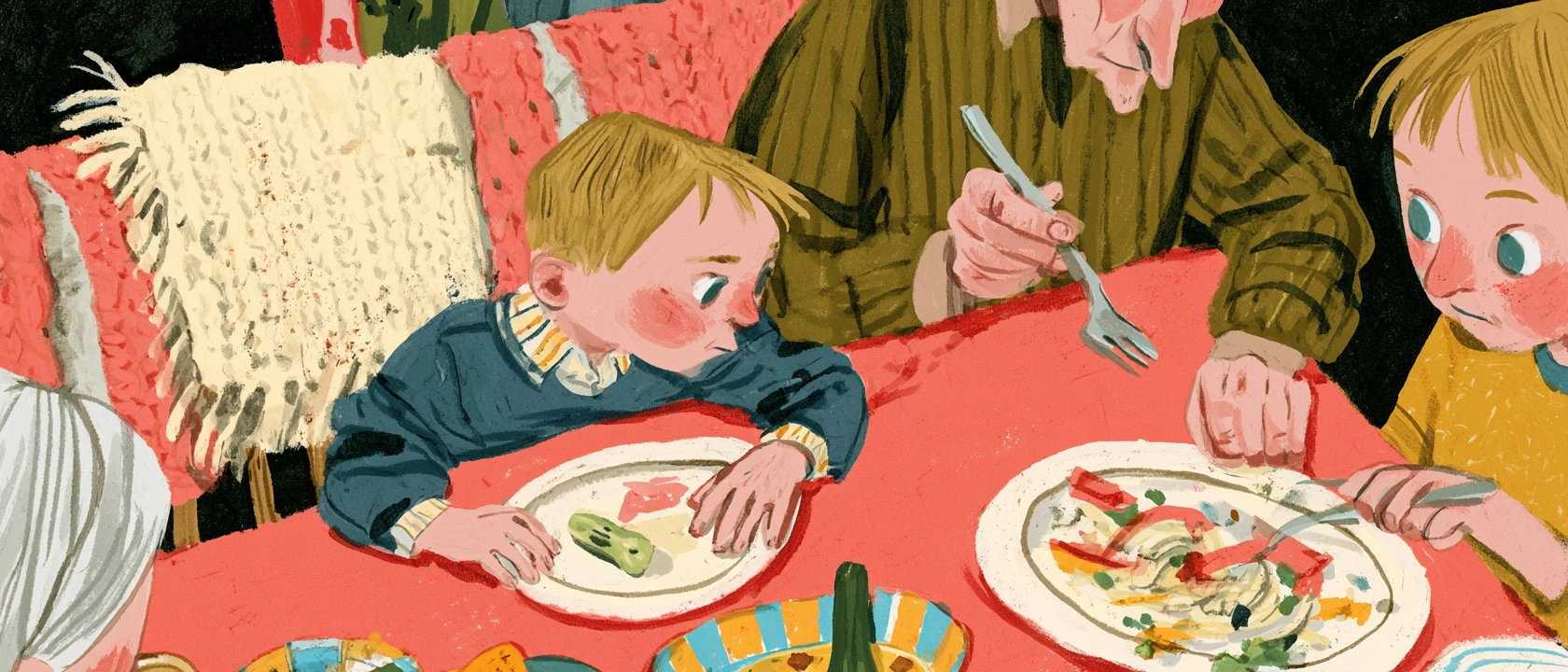
Eleven foods. That's the whole list.
Chicken nuggets from one specific brand, plain pasta, one shape of cracker, and eight other beige items your seven-year-old has eaten for three years straight. Tonight there's a new vegetable on the plate, because the pediatrician said keep offering it. Your kid isn't refusing it, exactly. He's gone pale looking at it.
Every parent of a picky eater knows dinner-table standoffs. But if the list never grows, if new foods trigger gagging or panic instead of complaining, you may be looking at something with a name: ARFID, avoidant/restrictive food intake disorder. And the difference matters, because the advice that fixes picky eating makes ARFID worse.
ARFID (avoidant/restrictive food intake disorder) is a recognized eating disorder in which a person restricts food intake enough to cause weight or growth problems, nutritional deficiencies, dependence on supplements, or significant disruption to daily life, according to the National Institute of Mental Health. Body image plays no role in ARFID; the restriction is driven by sensory distress, fear, or low interest in eating.
Picky eating lives on a spectrum nearly every child visits. ARFID sits past the edge of that spectrum, and the two behave differently under pressure. That difference is the most useful thing a worried parent can learn, so let's make it concrete. If you're already wondering whether it's time for your child to see someone, the sections below will help you sort it.
Picky eating vs ARFID at a glance
| Picky eating | ARFID | |
|---|---|---|
| What drives the "no" | A preference that softens with hunger, time and low-pressure exposure | Sensory distress, fear of what food might do, or low interest in eating |
| How refusal looks | Complaining and negotiating | Gagging, retching, panic or trembling at a sight, smell or texture |
| The food list over time | Slowly grows with age and exposure | Stays flat or shrinks, and dropped foods rarely come back |
| Under pressure | "Keep offering it" usually expands the list | Pressure usually shrinks the list and turns meals into a battle |
| Effect on life | Frustrating, but growth and plans stay on track | Can affect weight, growth or energy, and leads to skipped parties and sleepovers |
| Into adulthood | Most outgrow the worst of it | Persists far more often |
A picky eater's "no" is a preference with a volume knob. Turn the conditions (hunger, novelty fatigue, a friend eating the same thing, plain persistence) and the volume comes down. This is why the classic advice works on picky eaters: repeated low-pressure exposure genuinely expands their list over time. Most outgrow the worst of it.
An ARFID "no" runs through different wiring. The system trips before the food is even considered. Gagging at a smell from across the table. Panic when foods touch. A child who would rather leave the birthday party than sit near the cake. Flip the same exposure switch that helps a picky eater, and the breaker trips faster next time, because the table itself is becoming a threat.
Signs you're past picky eating:
One more distinction worth naming, because many parents carry this fear without saying it out loud: anorexia is driven by body image, and ARFID has a different engine entirely. Kids with ARFID usually want to be able to eat more things. They just can't get there through willpower, theirs or yours.
Clinicians generally see three drivers, alone or braided together.
Sensory sensitivity. Textures, smells, and appearances register with an intensity most adults never experience. This is also why ARFID overlaps so heavily with autism and other forms of neurodivergence: the same nervous system processing that makes a shirt tag unbearable can make a food's texture feel dangerous.
Fear of what food might do. A choking scare, a vomiting episode, one bad allergic reaction. For some kids the fear generalizes fast, and eating itself becomes the hazard.
Low interest in eating. Some kids register hunger weakly and experience little reward from food. Meals feel like an interruption, and they fill up in a few bites.
Notice what's missing from that list: defiance. In our work with families, the child at the table is usually working harder than anyone else in the room.
Here's the part that surprises parents most, and it's the reason this distinction deserves a whole post.
"They'll eat when they're hungry enough." "Keep putting it on the plate." "Don't cater to it, you'll reinforce it." For garden-variety picky eating, this playbook is fine. For ARFID, hunger frequently loses to the fear or the sensory alarm, and each pressured meal teaches the nervous system that the table is where bad things happen.
Pressure expands a picky eater's food list and shrinks an ARFID kid's.
The trajectory tells the story. If months of "keep offering it" have grown the list, you probably have a picky eater and time on your side. If months of it have shrunk the list and turned dinner into a battlefield, stop turning that dial. It's wired to the wrong system.
The stakes are real, and they're wider than nutrition.
Growth and energy suffer first, sometimes visibly, sometimes only in bloodwork. Then the world starts shrinking around the food list: birthday parties declined, sleepovers avoided, the cafeteria eaten alone or the lunch skipped entirely. Family life reorganizes around one plate: separate meals, restaurants ruled out, vacations planned around food access. And ARFID does persist into adulthood far more often than picky eating does, which means the shrinking can keep going for decades.
The hopeful flip side: this responds to treatment, and the earlier it starts, the less there is to unwind.
Treatment starts by changing what the table means. The core approach is graduated exposure therapy, the same family of treatment we use for obsessive-compulsive disorder (OCD) and anxiety, adapted for food: pressure comes off completely, safe foods get served without commentary, and new foods are reintroduced in small exposure steps the child helps choose. Looking, touching, smelling, licking, long before biting. The pace looks slow from the outside. It's the pace the nervous system can actually learn at.
At Layers, Rachel Tipsword, LCSW leads our ARFID work, with training in family-based ARFID treatment for kids and teens. Family-based means exactly what it sounds like: parents become part of the treatment team, because the table is where the work happens, and you're the one at the table. Rachel is also trained in SPACE (Supportive Parenting for Anxious Childhood Emotions), a parent-based approach that works even when a child refuses to attend sessions. Parents learn to shift the accommodations that have grown up around eating, and the child's flexibility grows from there.
ARFID also rarely arrives alone. In my own work, I see how often anxiety and OCD travel with restricted eating, and our team treats kids, teens, and adults across those overlaps, in English and Spanish, at multiple fee levels, so the whole picture gets one coordinated plan.
They sit on the same behavioral surface with different machinery underneath. Picky eating is preference-driven and typically improves with age and gentle exposure. ARFID involves fear, sensory distress, or absent appetite strong enough to cause nutritional, growth, or social consequences, and it worsens under the pressure that helps picky eaters.
Picky eating usually fades with age; ARFID usually holds without treatment, and it can follow a person into adulthood. That's the core reason the distinction matters early. The good news is that ARFID responds well to graduated, pressure-free exposure treatment, especially when families are trained to run the approach at home.
Three drivers show up most, often combined: heightened sensory sensitivity (common in autistic and otherwise neurodivergent kids), fear following a bad experience like choking or vomiting, and genuinely low appetite or interest in food. What clinicians consistently rule out is willful defiance. The restriction is protective, from the child's side.
Talk to your pediatrician or a therapist when the food list is shrinking rather than slowly growing, when refusals involve gagging or panic, when weight, growth, or energy are affected, or when your child starts avoiding social situations because food will be there. Any one of those moves the question from preference to treatment.
It's time for an evaluation if:
Back to the eleven-food kid at the table. In treatment, the twelfth food arrived weeks after the standoffs stopped. Chosen by him, touched before tasted, next to a plate of the nuggets he trusts. The list grows the way it shrank. One food at a time, with the pressure off.
If you or someone you love is in crisis:
If this sounds like your table, our ARFID treatment in Plano was built for it. Layers Counseling Specialists is based in Plano, Texas, serving families across the DFW area. You can request an appointment with our team, and bring the food list. It's exactly the place to start.
By Karla Pineda, LPC
Last reviewed: July 2026
This article is for educational purposes and is not a substitute for professional medical advice. If you or someone you know is in crisis, call or text 988 (Suicide & Crisis Lifeline) or text HOME to 741741.
Our Plano therapists specialize in OCD, anxiety, ADHD, autism, ARFID and trauma, in person or online anywhere in Texas. Every clinician starts with a free 15-minute consultation, so you can see whether it feels like a fit before you commit.
arfid
ARFID
arfid