By Karla Pineda, LPC · Last reviewed: July 2026
"She's just a perfectionist."
That's what everyone said about the sophomore with the color-coded planner. Her teachers praised how carefully she checked her work. Her parents wondered why homework took four hours, but the grades were good, so nobody worried.
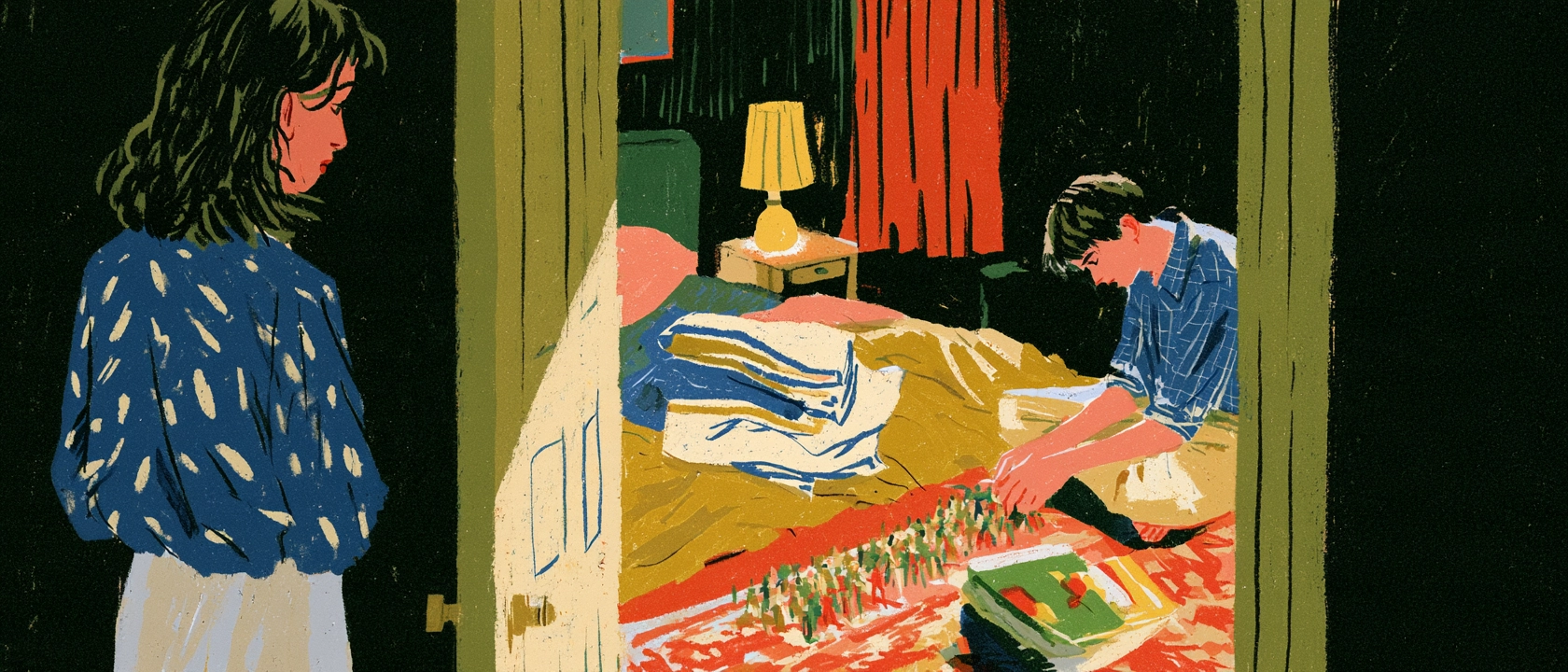
Then her mom noticed the page. The same page of the same book, open on her desk three nights in a row, because she had to re-read every paragraph until it felt finished. What looked like diligence had been running her evenings for a year.
Obsessive-compulsive disorder (OCD) in teens has a disguise problem. The famous signs, like scrubbed-raw hands and flipped light switches, are the ones parents catch. The signs of OCD in teens that get missed look like good habits.
Signs of OCD in teens include repetitive checking, re-reading or re-writing schoolwork, excessive reassurance-seeking, mental rituals like counting or silently repeating phrases, and avoiding whatever triggers the fear. OCD affects an estimated 1% to 3% of children and teens, according to the American Academy of Pediatrics, and it often emerges or intensifies during adolescence.
Teen OCD hides inside behaviors that adults reward. In our work with families at Layers, these are the versions parents describe once they know what they're looking at:
Some teens also carry intrusive thoughts they'd never say out loud: violent images, taboo sexual thoughts, fears of harming someone they love. These horrify the teen precisely because they collide with who the teen actually is. We've written about why scary thoughts don't mean what parents fear, and the same principle holds at fifteen.
Teens hide symptoms more than any other age group. Younger kids narrate their fears. Teenagers, wired for privacy and terrified of being weird, manage theirs alone, often for years.
OCD attaches itself to whatever a person values most. For a teenager, that's usually school performance, friendships, morality, and identity, so the compulsions grow in exactly the places where effort gets rewarded.
A teen checking a math problem eleven times looks hard-working. A teen mentally reviewing a conversation for evidence she offended someone looks thoughtful. The International OCD Foundation notes that the disorder is defined by function, and function is invisible from the outside. The question that separates diligence from compulsion is simple to ask: does the behavior serve a goal, or does it serve a fear?
Diligence finishes. A diligent student checks the essay once and submits it. A compulsion has no finish line, because its real job is to make a feeling of doubt go away, and doubt regenerates.
Karla often tells parents that a compulsion works like a payday loan. The anxiety spikes, the ritual delivers relief now, and the cost gets deferred. Every repetition raises the interest rate: the doubt returns sooner, demands more, and spreads to new territory.
The compulsions most likely to go unnoticed are the ones that earn praise.
Here's where families get pulled in without realizing it. When you answer the same question a fifth time, proofread the essay again at midnight, or drive back home to confirm the straightener is off, you become the loan's co-signer. Your reassurance is a payment on your teen's behalf. It comes from love, and it keeps the account open.
Research on family accommodation shows this pattern in most families of kids with OCD. It also shows that reducing it, gradually and with support, improves treatment outcomes. That should read as good news. Parenting choices did not cause the OCD, and parenting choices are one of the strongest levers for shrinking it.
The loan gets called. Rituals multiply and take more of the evening, then the morning, then the weekend. Grades often hold for a while on sheer effort, then drop suddenly when the time debt becomes unpayable.
Social life narrows, because friends might trigger obsessions or witness rituals. Depression and anxiety commonly move in alongside untreated OCD in adolescents. And the teen builds a private explanation for all of it, usually some version of "something is wrong with me," that can take years of adult therapy to unwind.
Early treatment interrupts every part of that trajectory.
The gold-standard treatment for teen OCD is exposure and response prevention, or ERP. In ERP, a therapist helps your teen approach the feared thought or situation on purpose, in small graded steps, while resisting the ritual. The doubt shows up, crests, and passes without the compulsion, and the brain relearns that the loan was never necessary.
As an IOCDF-registered ERP therapist, Karla Pineda leads OCD treatment at Layers, and the team covers the full age range: Rachel Tipsword's ERP training for children and adolescents anchors our work with younger teens and kids, and Spanish-language OCD treatment is available. Parents get a defined role in treatment too: learning how to step back from co-signing, at a pace the therapist structures so nobody goes cold turkey on day one.
For some teens, medication alongside ERP helps, which is a conversation for your pediatrician or a child psychiatrist.
Look at time and interference. Rituals and quirks that a teen can skip without meltdown are usually habits. When the behavior consumes an hour or more a day, or when interrupting it produces distress far out of scale, it's time for a professional screening.
Rarely without treatment. OCD tends to wax and wane, which fools families into waiting, since every ebb feels like the end of it. The long-term trajectory of untreated OCD usually points toward more territory, and ERP reliably changes that trajectory.
No. OCD develops through a mix of genetics and brain chemistry, and it shows up in loving, stable homes all the time. Family responses can feed the maintenance cycle once OCD exists, and that's the useful part, because family behavior is the piece you can change starting this week.
Repeated asking after clear answers is usually reassurance-seeking, one of the most common hidden compulsions. The answer soothes for a shrinking window, then the doubt returns. Treatment teaches teens to tolerate the doubt directly, and teaches parents supportive ways to respond without feeding the loop.
Reach out for an evaluation if you're seeing:
Layers Counseling Specialists is based in Plano, Texas, and works with teens and families across the DFW area. If the sophomore with the color-coded planner sounded familiar, our OCD therapy team in Plano can help you figure out what you're looking at. Request an appointment here.
The planner stays color-coded, by the way. She's still a careful kid after treatment, and the care finally belongs to her. The loan is paid, and the page turns.
This article is for educational purposes and is not a substitute for professional medical advice. If you or someone you know is in crisis, call or text 988 (Suicide & Crisis Lifeline) or text HOME to 741741.
Our Plano therapists specialize in OCD, anxiety, ADHD, autism, ARFID and trauma, in person or online anywhere in Texas. Every clinician starts with a free 15-minute consultation, so you can see whether it feels like a fit before you commit.
ocd
OCD
ocd