The woman in the chair had not moved for six minutes.
She had touched the underside of her shoe, then the arm of the chair, and then she had put her hands open on her knees and left them there. No sink. No wipe. Her therapist was not doing much either. From the hallway it would have looked like two people who had run out of things to say.
That stillness was the treatment. Most people walk into obsessive-compulsive disorder (OCD) treatment having heard of the part where you face the fear. The part where nothing visible happens is the part that changes symptoms, and almost nobody has had it explained to them.
Exposure and Response Prevention (ERP) is a structured therapy for obsessive-compulsive disorder in which you practice facing a trigger on purpose and then skip the ritual that normally follows. At Layers Counseling Specialists in Plano, Texas, it is our first-line OCD treatment for children, teens, and adults.
That definition is simple. Doing it is not, because OCD has spent years teaching you that the ritual is the only thing standing between you and catastrophe. If you want the inside view first, we have written about what OCD actually feels like from the inside.
ERP starts with a map.
Your first sessions are spent building a list of the situations that set off obsessions, and the compulsions you run in response to each one. The list gets ranked, gently, from the things you could face this week to the things that feel unthinkable right now. You are never handed the hardest item first. Nothing on that list happens without your agreement.
From there, sessions look like practice. A therapist might ask you to:
Between sessions you practice on your own, which is where most of the change accumulates. Your therapist is there to sit beside you while your brain collects information it has never been allowed to collect.
Compulsions work, which is the whole problem.
Washing, checking, reviewing, asking your partner one more time: each of those drops the anxiety within minutes. Your brain records the drop and draws a reasonable conclusion. The ritual saved you. Do it again next time, faster. That is a learning system doing exactly what learning systems do, with bad inputs.
The International OCD Foundation describes ERP as retraining that pattern by practicing the trigger and choosing not to perform the compulsive behavior. When you stay in the situation without the ritual, your brain finally gets access to two pieces of data it has never had: the feared thing did not happen, and the discomfort was survivable without the ritual.
Think of it like something in the oven. The learning needs undisturbed time to set.
The most common reason ERP stalls is an invisible compulsion running underneath it.
Someone does the exposure perfectly. They touch the doorknob, they leave the stove, they sit with the awful thought. And then, silently, they review the day to make sure nothing bad happened, or replay the moment to check how anxious they felt, or text a friend a casual question that is really a request for reassurance. The exposure happened. The learning got cancelled.
Every reassurance check opens the oven door, and the learning starts over from cold.
This is why mental compulsions matter so much in treatment. They are harder to spot than handwashing, they feel like thinking rather than doing, and they are often the last thing to be named in a course of ERP. We wrote a whole post on how reassurance-seeking works as a mental compulsion, because it is the one that hides best.
The exposure is the invitation. The response prevention is the answer your brain is listening for.
OCD tends to be a long-running condition rather than a phase that resolves on its own.
The National Institute of Mental Health reports that about half of adults with OCD experience serious impairment in daily life. What that looks like in practice is a life getting smaller by degrees: the job taken because the commute avoids a certain road, the friendships that thin out because hosting became impossible, the mornings that start ninety minutes early to leave room for the ritual.
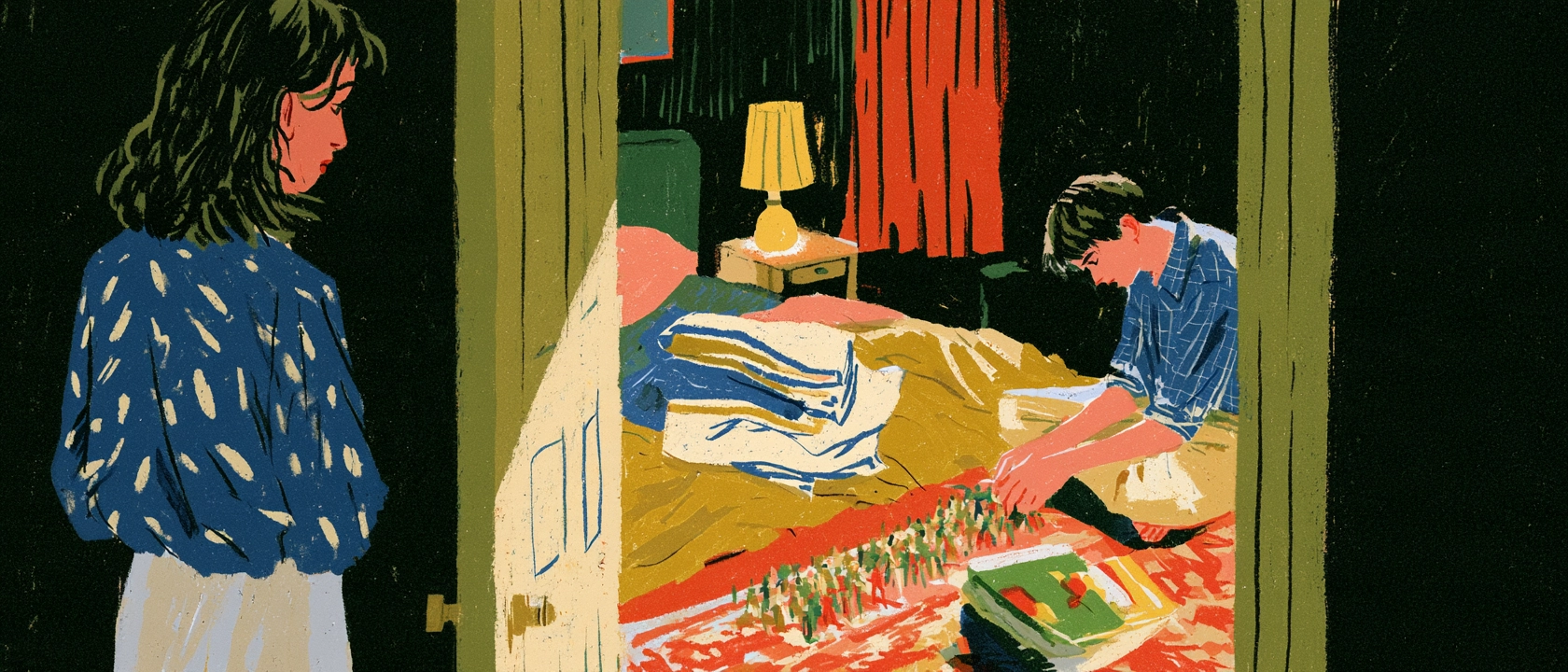
Family members get recruited too. Partners start answering the same question nightly, parents start doing the checking, and the accommodation that came from love ends up holding the whole system in place. None of this means someone was careless. It means OCD is very good at what it does, and it rarely stops being good at it without treatment.
Our practice treats OCD across the full age range, in two languages.
Karla Pineda's ERP work with adults and teens is anchored in her registration as an International OCD Foundation ERP therapist, with a focus on mental compulsions, postpartum and perinatal OCD, and OCD treatment delivered in Spanish. Rachel Tipsword, LCSW, carries the pediatric side, working with kids and teens whose rituals have started reshaping the family's evenings.
Isaac Rosas, LMSW, provides ERP in English and Spanish, including with children, and brings thirteen years in public education to the work with families.
When ERP is a poor fit, or when someone has already tried it and stalled, there is a second evidence-based path. Inference-Based Cognitive Behavioral Therapy (I-CBT) targets the obsessional doubt itself rather than the compulsions, and we explain the difference in our post on what I-CBT is and how it treats the doubt.
Sessions are available in person at our Plano, Texas office and online across the state.
Does ERP actually work for OCD?
Exposure and response prevention has more research support than any other psychological treatment for obsessive-compulsive disorder, and the International OCD Foundation identifies it as the first-line approach. It does not work for everyone, and it works best when the compulsions being prevented include the mental ones. People who stall in ERP often have an untreated hidden ritual.
How long does ERP therapy take?
ERP (exposure and response prevention) is a time-limited treatment rather than open-ended talk therapy, and most people work weekly for a matter of months rather than years. The pace depends on how many symptom areas are active, how much practice happens between sessions, and whether anything else needs attention at the same time, such as trauma or depression.
Will my therapist make me do something extreme?
No. Exposure and response prevention is collaborative, and every exposure is agreed on before it happens. The list is built together and worked from the bottom up. Nobody is going to surprise you with a trigger, and nothing you see in films about exposure therapy resembles a real session. You keep the right to stop at any point.
I tried exposure therapy before and it did not help. Now what?
That is worth taking seriously rather than repeating louder. Two things are worth checking: whether mental compulsions were being run during the exposures, and whether the treatment was delivered by someone trained specifically in ERP for OCD. If both were in place, Inference-Based Cognitive Behavioral Therapy (I-CBT) is a genuinely different path, working on the doubt rather than the ritual.
It is time to call when:
Six months after that six-minute silence, the woman in the chair still gets the thought at the doorknob. She described it as background noise now, the kind you notice and keep walking past. The thought did not leave. Her life got bigger anyway.
If OCD has been shrinking yours, our OCD treatment in Plano starts with a free fifteen-minute consultation, so you can hear how ERP would work for your symptoms before committing to anything. Book a consult whenever you are ready.
By Karla Pineda, LPC
Karla Pineda, LPC is the Executive Director of Layers Counseling Specialists in Plano, Texas. She is registered with the International OCD Foundation as an ERP therapist, holds certifications in ERP (CBI), Rumination-Focused ERP, and Advanced Accelerated Resolution Therapy, and provides OCD treatment in English and Spanish.
Last reviewed: September 2026. This article is for educational purposes and is not a substitute for individual clinical advice. If you are in crisis, call or text the 988 Suicide & Crisis Lifeline.
Our Plano therapists specialize in OCD, anxiety, ADHD, autism, ARFID and trauma, in person or online anywhere in Texas. Every clinician starts with a free 15-minute consultation, so you can see whether it feels like a fit before you commit.
ocd
Exposure & Response Prevention
exposure-response-prevention